Collaboration | Co-Creation | Capacity Building | Communication
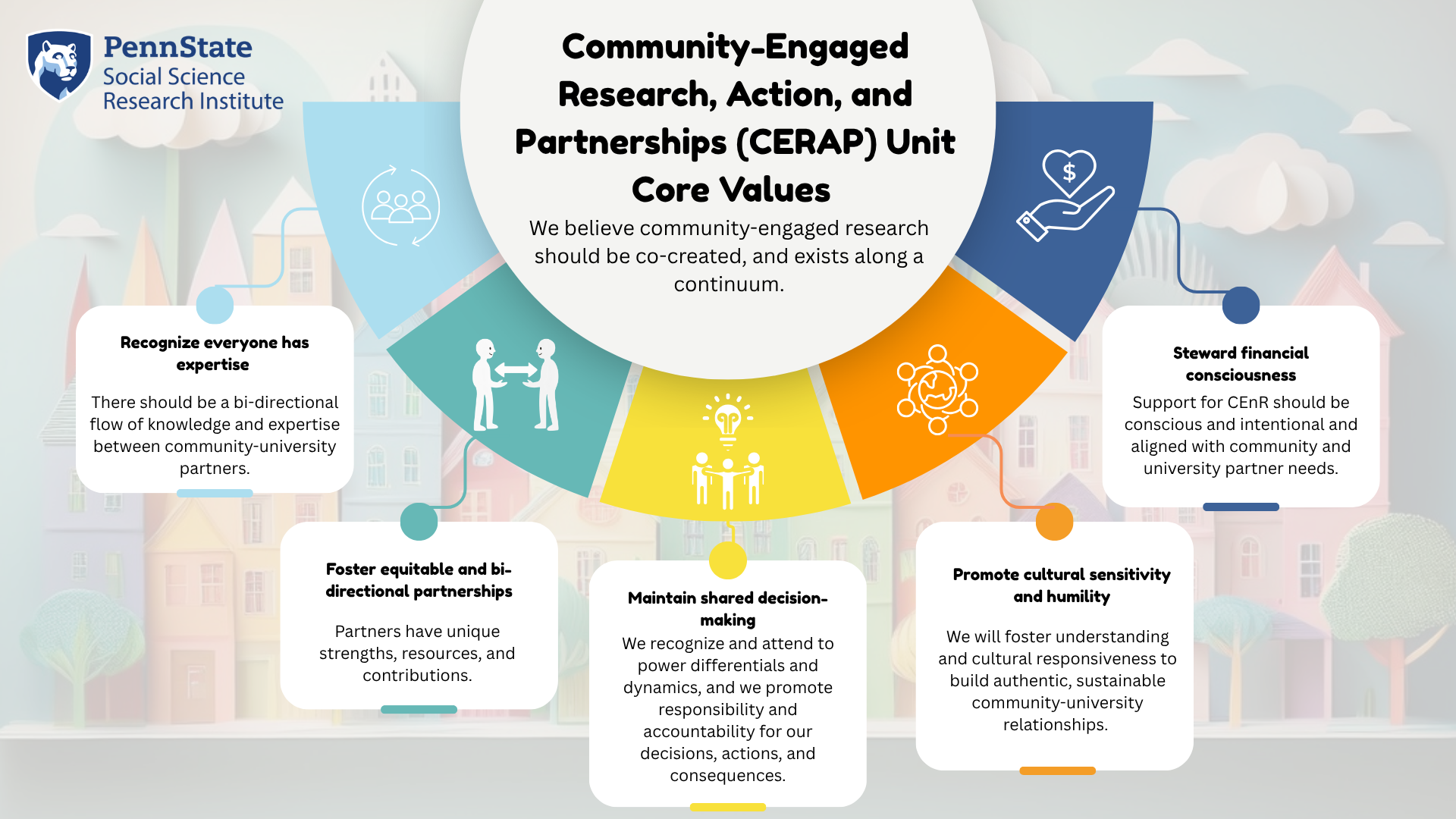
The Community-Engaged Research, Action, and Partnerships (CERAP) unit is led by an interdisciplinary team of community engaged faculty and researchers who are committed to advancing community-driven research that improves lives, strengthens communities, and benefits society. Community-university partnerships—also referred to as engaged or public scholarship—are collaborations between community-based groups and higher education institutions working together to co-create new knowledge, policies, and/or practices that promote individual and social transformation. Our approach involves community members and university researchers as partners, and it is grounded in our commitment to co-investigation, co-creation, and co-learning.
Interested in a consultation with the CERAP Team? Please fill out this brief form, and we will be in touch.

Objectives
The Community-Engaged Research, Action, and Partnerships (CERAP) Unit is focused on increasing the Social Science Research Institute’s capacity to:
- Build community-engaged research capacity through trainings, symposia, and intensive, interactive workshops.
- Promote transformative, ethical, reciprocal, and sustainable community-university partnerships.
- Increase accessibility of research and information to community and university audiences through innovative dissemination methods.
- Act to address community-driven priorities and pressing social issues.
What We Do
- Consultations and collaborations
- Trainings
- Resource hub for community and university researchers
- Tool and method development
- Events and speaker series
- Community and university capacity building
- Institutional change work


Summer Institute
The CERAP Unit hosted its first Summer Institute on Community-Engaged Research from Tuesday, June 2nd - Wednesday, June 3rd. The Institute brought together community partners and Penn State faculty and staff for two days worth of workshops, symposia, and training. Day 1 focused on Research Practice Partnerships, Policy, and Public Impact, while Day 2 was an intensive Methodology Boot Camp focused on Youth Participatory Action Research. More information about our 2026 Summer Institute can be found in the attached report. CERAP would like to thank all of our speakers, attendees, staff and students for helping us to make this a successful event, and we look forward to hosting more annual Summer Institutes in the coming years!

Monthly Huddles
What is the Huddle?
The Huddle is a community of practice for community-engaged researchers who share a commitment to equitable, sustainable, reciprocal, transformative community-engaged research. The goal of this community of practice is to build relationships with others who are passionate about co-creating research with community members and want to learn how to do it better. Through regular gatherings, we will share ideas, resources, tools, and build a culture of support. Building on our collective knowledge and expertise, the topics and themes for each session will come from Huddle participants who are invited to present ongoing work, workshop a dilemma or challenge, pilot measures, share resources, lead topical discussions, practice activities, and more! We invite our colleagues to join us to build the Huddle as a space for supportive relationships and capacity building.
Upcoming Huddle Dates:
- September 4, 2026
- October 2, 2026
- November 6, 2026
- December 4, 2026
The monthly Huddles are hybrid events. In-person room details (at University Park) and Zoom link will be provided upon RSVP each month.
Please note that providing a hybrid virtual/in-person format reflects our commitment to ensuring equitable access to opportunities for capacity building to the university-wide community across the Commonwealth


